Friday, March 10, 2017

Language Group Week of March 6, 2017

Community Helpers
Image result for community helpers

 
This week in Language Group we talked about Community Helpers.  The children were asked the following questions:

What community do you live in?
What community helpers are in the town of Franklin?

We then played a community helper guessing game.  The children were tthe detectives and had four clues to try to figure out the community helper.


Things you can do at home include:
1.  visit community helper sites
2.  talk about community helpers when you see them 
(what they drive, what they do, what they wear)
3.  pretend to be a community helper during play
(grocery store, fire fighter, police officer)
4.  play 'red light green light'

Miss Diane and Miss Linda


Monday, February 6, 2017

Language Group - Week of February 6, 2017

Woodland Animals


Today in Language Group, we talked about forest animals.  We read the book “Don’t Wake Up the Bear” by Marjorie Dennis Murray.  This book is about a big, soft, warm Bear who is asleep in his cave during the winter.  Different animals walked by the cave and saw the Bear asleep.  Each animal had a body part that was cold and thought the Bear looked warm (“My ears are so…cold,” thought the hare.  “I wish I could snuggle up with the big, soft, warm Bear.”  And since her ears were so cold, and the Bear was fast asleep, she did.)  The animals that snuggled with the Bear include: a hare with cold ears, a badger with a cold nose, a fox with cold legs, a squirrel with cold toes, and a mouse with a cold tail.  The mouse was curled up in the Bear’s ear and had the sniffles.  The other animals kept telling her to quiet down and “Don’t wake up the Bear!”  The mouse sneezed right in the Bear’s ear and woke him up.  The Bear was very hungry.  He saw all the animals, growled and all the animals ran away.  The Bear yawned and walked off through the snow to look for some food.
Image result for Don't wake up the bear

For our activity we played a game called “Don’t wake the Bear!”  One child was the Bear and curled up pretending to be asleep.  The other children crawled around the Bear, while we said:

Slowly.  Slowly. Quietly.  Quietly.
We are creeping. See if he/she is awake.
To the cave, If he/she doesn’t answer,
Where Bear is sleeping. Give the Bear a shake.

One child shook the Bear to wake him/her up.  When the Bear woke up, he/she growled and chased the other children.  Whoever was caught was the Bear next.

This activity worked on:
  1. attending
  2. turn-taking
  3. vocabulary related to animals and body parts
  4. labeling/naming various animals and body parts
  5. adjectives – slowly and quietly
  6. pronoun use – he/she
  7. following directions

Activities you can do at home include:
  1. The same activity we did with family members.  Identify if the Bear is a boy or girl (he/she) and has a location for the cave.
  2. Go for an animal walk and identify all the animals you see.
  3. Model the correct pronoun use emphasizing the appropriate pronoun.  If your child uses a name, repeat what they have said using the appropriate pronoun (i.e.: John wants blocks.  He wants blocks.).
  4. Sing “Head Shoulders Knees and Toes”
  5. Play a game of giving directions using adjectives (i.e.: run fast, walk slowly, hop quickly, clap softly).
  6. Try this poem ! - “Five Little Bears”

Five little bears were dancing on the floor.
One fell down and that left four.
Four little bears climbed up a tree.
One found a bee hive and that left three.
Three little bears were wondering what to do.
One chased a bunny rabbit and that left two.
Two little bears were looking for some fun.
One took a swim and that left one.
One little bear sitting all alone.
He looked around and then ran home.

Miss Diane & Miss Linda

Wednesday, February 1, 2017

Language Group - Week of January 30, 2017

Woodland Animals


This week in language group, we have begun the unit on woodland animals.  The children were encouraged to name the woodland animals they know.  Some examples of what has been named includes, bears, deer, skunks, and squirrels.

Two scenes were placed on the floor in front of the children, a farm scene and a forest scene.  A pile of animals were placed on the floor as well.  Each child had an opportunity to choose a picture from the pile.  They were each asked, "What is it?"  and "Where does it live?"  If the child needed some assistance, choices were given or the children were encouraged to ask a friend for help.  When the child asked a peer for help, they were instructed on how to do that, "Call your friends name and ask, What  is this?/Where does it live?"


Once the child identified the animal and where it lives, they then placed the animal on the picture.  We talked about what the animal looked like, if it was able to climb trees, and where they placed the animal (high/low, up/down, tree/ground).


This activity worked on:
1.  attending
2.  turn-taking
3. vocabulary related to woodland animals
4.  location vocabulary
5.  categorizing (farm animals/woodland animals)
6.  answering a variety of questions (wh- and yes/no)
7.  engaging peers
8.  asking for assistance

Things you can do at home:
1.  Go for a walk and talk about the animals you see.
2.  Cut out pictures of different animals and sort them by
where they live, fly/walk, big/little, etc.
3.  Talk about the location of items.  Give your child directions
on where to put items (in, out, on, under, up, down, etc.)
4.  Ask your child a variety of questions (yes/no, who, what, where).
5.  Check out this website for free woodland animal printables!


Miss Diane & Miss Linda

Tuesday, January 17, 2017

January - Leo Lionni Author Study


This month we are studying Leo Lionni the author of many wonderful books!
The following activities will be done during language group throughout this unit!


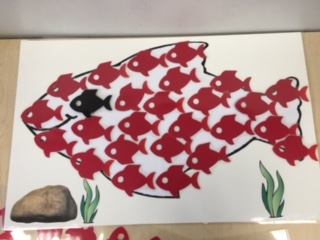
In the corner of the sea there lived a happy school of little red fish. There was only one fish that was black, Swimmy.  One day a big Tuna fish swam by and gulped all the little red fish, except for Swimmy.  Swimmy swam away to the deep sea, seeing a lot of different sea creatures on his journey.  He finds a school of red fish, just like the other school of fish.  Swimmy tries to get them to swim and play, but they are too afraid and just want to hide.  Swimmy shows his friends how to work together by swimming in the form of a larger fish.


For our activity, each child will have an opportunity to spin a spinner.  They then have to identify the number, count the correct number of fish and place them on the larger fish picture.  The larger picture will be the small fish in the shape of a large fish.

swimmy.jpg


This activity works on:
  1. Turn taking
  2. Number identification
  3. Counting
  4. Answering ‘How many?’
  5. Following directions


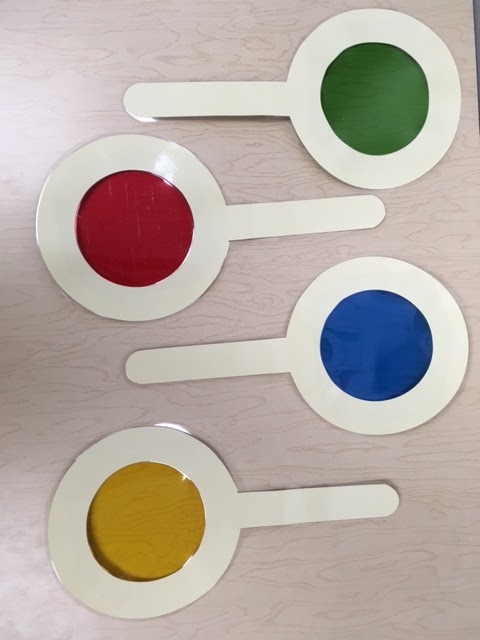
Little blue and little yellow played together because they were best friends.  One day, little blue goes looking for little yellow everywhere!  Little blue finally finds Little Yellow and they hug until they turn green.  When they were done hugging, they went off to have more adventures.  When they went home, their moms and dads said, “You are not our little blue/yellow-you are green.”  They were so sad that they cried blue and yellow tears.  They turned back to their original colors after they cried.  Everyone was happy.


For our  activity, large magnifying glasses were made with different colored cellophane.  A flashlight and two different colors will be used to make a new color.  The children will make guesses as to what color will be made by putting the two colors together over the light.
Magnifying.jpg


This activity works on:
  1. Turn-taking
  2. Color identification and labeling
  3. Making a prediction
  4. Answering wh- questions (i.e.: What color?)
  5. Following directions


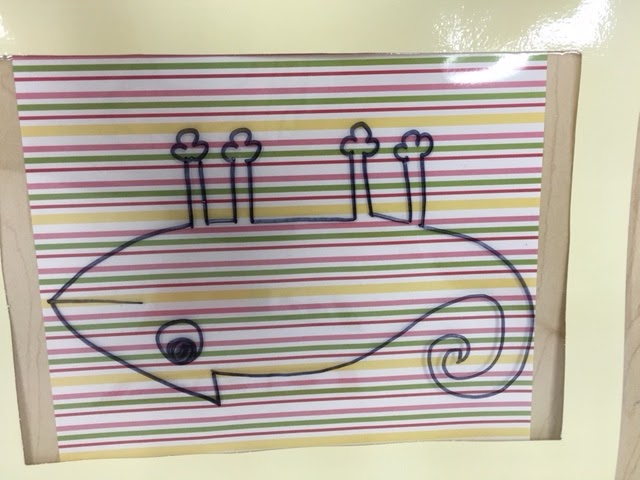
This books talks about the different colors that animals are.  Chameleons “change color wherever they go.”  The book then shows chameleons on different items and how the chameleon changes its color to look like the item…”And on the tiger they are striped like tigers.”  One day a chameleon wanted to have his own color so he sat on a leaf thinking, “I too will have a color of my own.”  The chameleon who thought he would be green forever changed color with the seasons.  He was sad and found another chameleon who he told his story to.  In the end, they decided to stay together so they would always be alike.  “We will still change color wherever we go, but you and I will always be alike...And they lived happily ever after.”


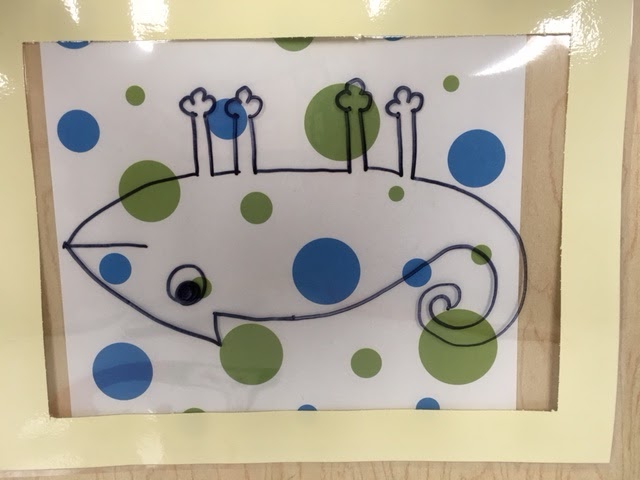
For our activity, a chameleon was traced on a laminating sheet, so it was clear.  We will discuss camouflage and how the chameleon changes it’s color when it’s on something.  Different paper will be used to demonstrate that (stripes, polka dots).  Then the chameleons will be taped around the room for the children to find.  We will discuss how the chameleon looks over the item behind it (color, pattern, etc).

Chameleon2.jpgChameleon1.jpg


This activity works on:

  1. Turn-taking
  2. Vocabulary - camouflage, descriptor words (color, pattern words, etc.)
  3. Following directions


Miss Diane & Miss Linda